Research

Mechanisms of cellular adaptation during developmental transitions

I study how differentiated cells adjust gene-expression output, reorganise their physiology and remain functional as development changes the demands placed upon them. My work centres on post-transcriptional regulation, RNA–protein organisation and the physiological limits of cellular adaptation.

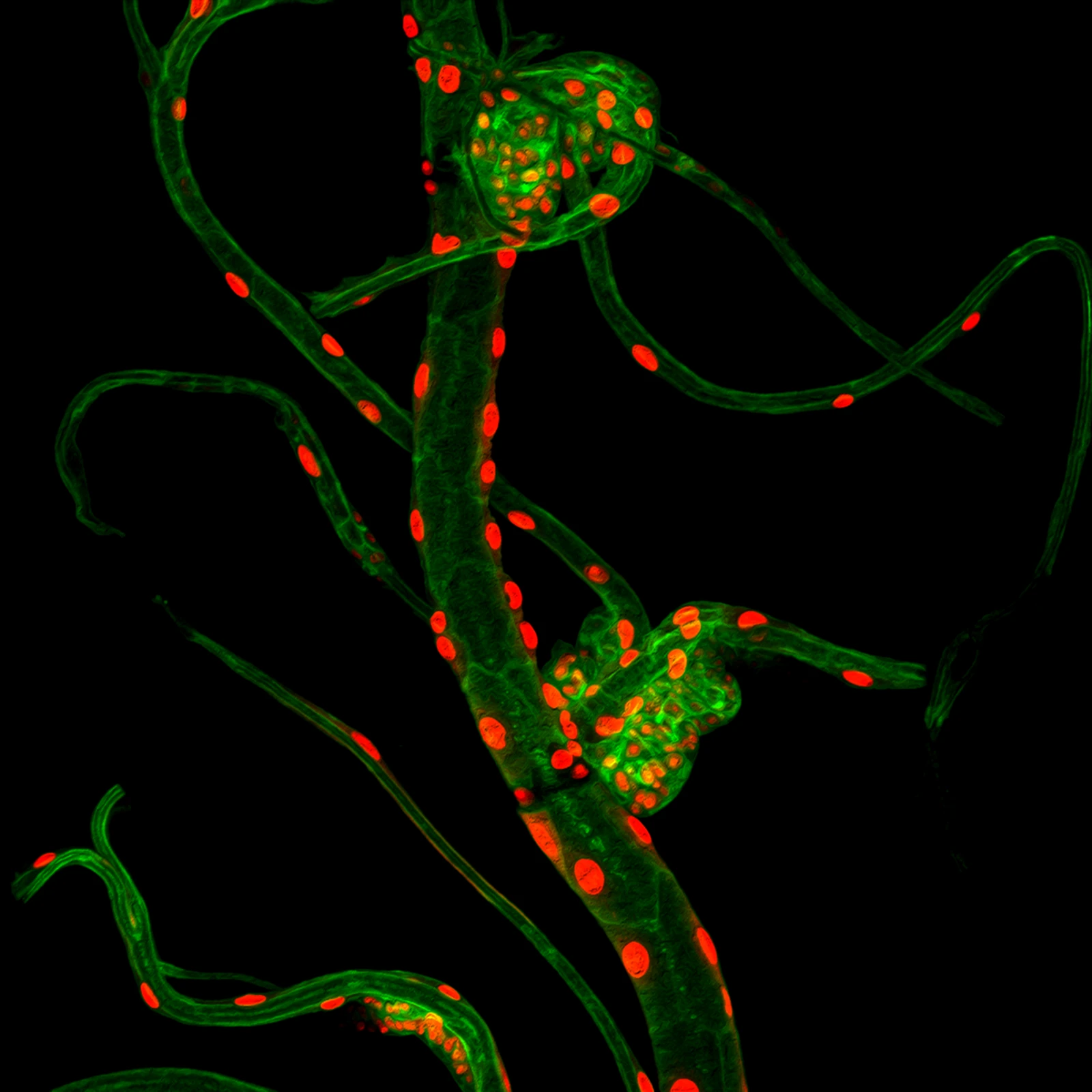
Confocal microscopy image from developmental biology research
Confocal microscopy. Image: Panagiotis Giannios.
01

The biological problem

How do differentiated cells adapt to a common developmental signal?

Developmental transitions expose many cell populations to the same systemic endocrine environment. Their responses, however, are not uniform: cells may maintain their function, alter their activity, contribute to tissue remodelling or be eliminated.

My research asks how rapid regulatory mechanisms operating after transcription allow differentiated cells to adjust their behaviour without necessarily changing their identity. I use the larval-to-adult transition as an experimentally tractable system in which hormonal signalling, stress responses, post-transcriptional control, genome amplification and cell elimination can be examined within a shared physiological context.

Development provides a controlled setting for identifying general principles. The same mechanisms that coordinate cellular adaptation during normal development may, when disrupted or no longer properly integrated, produce persistent or inappropriate changes in cellular function and contribute to disease.

Central questionHow do post-transcriptional regulation, RNA–protein organisation and cellular physiology determine whether a differentiated cell can adapt to a developmental transition?
02

Connected research questions

Post-transcriptional control and RNA–protein organisation

Changes in transcription are only one way in which cells respond to developmental signals. Existing mRNAs can also be rapidly redirected between translation, temporary storage and degradation. I study how RNP granules—including stress granules and P-bodies—organise this regulatory layer, and how their assembly, composition and material properties influence the availability of selected RNAs for protein synthesis. I am particularly interested in the contribution of biomolecular condensation and liquid–liquid phase separation to these dynamic processes.

Endocrine regulation beyond transcription

Hormones are commonly understood to regulate development through transcriptional programmes. My hypothesis work extends this view by considering how endocrine signals may also alter the assembly, composition and physical state of RNP granules through transcription-dependent routes or faster non-genomic mechanisms. In turn, RNP granules can shape hormone-driven responses by controlling the translation, stability, storage and degradation of selected transcripts, creating a bidirectional relationship between endocrine signalling and post-transcriptional organisation.

Stress adaptation and Headcase

Developmental transitions impose metabolic, biosynthetic and organisational stress. Cells must preserve protein synthesis and RNA regulation while adapting to changing physiological demands. My work on Headcase identifies an evolutionarily conserved family of RNP-granule proteins involved in stress-granule and P-body organisation, translational control and protection from cellular stress. This provides an experimental route for examining how post-transcriptional organisation supports cellular resilience.

Physiological limits of adaptation

Cellular adaptability is not unlimited. Increased genome content can support specialised function, but it also changes cell size, biosynthetic demand and intracellular scaling. I investigate polyploidy as one physiological condition that may alter the balance between regulatory demand and cellular capacity. Here, ploidy is not the sole subject of the programme, but a tractable way to examine why a regulatory system that is effective at one scale may become insufficient at another.

When adaptation is insufficient: remodelling and cell elimination

When adaptive and homeostatic mechanisms are no longer sufficient, cells may enter programmes of remodelling or elimination. My research has examined how autophagy contributes to developmental histolysis and how this response relates to genome amplification. Autophagy is considered here as part of the machinery engaged when the balance between developmental demand and cellular capacity can no longer be maintained.

03

Interdisciplinary biophysics

Biomedical optics and quantitative tissue characterisation

A complementary strand of my research lies at the interface of biology, physics, engineering and clinical medicine.

Within biomedical optics, I have investigated the optical properties of freshly excised human tissue samples and developed approaches for characterising light–tissue interactions. This work examines how physical measurements reflect biological organisation and whether optical properties can support clinically relevant distinctions between tissue conditions.

It has included studies of refractive behaviour in normal and pathological tissues, methodological development for measuring attenuating biological media, and collaboration across experimental, physical and clinical disciplines.

See biomedical optics publications
04

Direction and selected contributions

From cellular adaptation to tissue plasticity and disease

The long-term aim of my research is to understand how dynamic RNA–protein organisation enables differentiated cells to adjust their function in response to systemic signals, and how physiological constraints limit this regulatory flexibility.

During normal development, these mechanisms must be coordinated across cells and tissues to preserve function while allowing extensive remodelling. When that coordination is defective—or when adaptive responses become persistent, insufficient or inappropriate—the same regulatory processes may contribute to pathological changes in cellular behaviour.

These principles may be relevant to regeneration and ageing, as well as to pathological polyploidy, tumour adaptation, treatment resistance and other disease-associated transitions in cellular function.

View the full publication record